Framework in action
Every CKF project is organized around five operational areas — from mapping the territory to creating sustainable economic models. They can be applied independently or as a progressive sequence, with each area building on the outputs of the previous one.
AREA 1
Territory Mapping
AREA 2
Heri-telling & interviews
AREA 3
Heritage Transmission
AREA 4
Cultural itineraries
AREA 5
Sustainable Models
AREA 1 — Territory Mapping & Knowledge Keeper Identification
Every project begins in the field: identifying and formally engaging the Knowledge Keepers of a territory — farmers, artisans, weavers, bakers, musicians — and mapping the full creative value chain from raw material gatherers to end audiences. Where needed, CKF assists practitioners in registering their practice legally. Documentation without protection creates cultural vulnerability: this step closes that gap.
Tools: Creative Knowledge Platform · Trustwave App.
AREA 2 — Heri-telling & Participatory Documentation
Heri-telling captures the stories and emotional significance that give a tradition its meaning. Trained Knowledge Seekers conduct field interviews; all content passes through the CKP’s AI-assisted Approval Process — what enters the archive is the community’s own voice. A Knowledge Keeper who enters this process exits with a certified profile, protected assets, and direct connections to the markets that can sustain her practice. Documentation is the first act of economic justice.
Tools: Trustwave App · Creative Knowledge Platform · GAMEO™ · TRusT™
AREA 3 — Education & Intergenerational Transmission
Tacit knowledge cannot be transmitted through documentation alone — it requires human encounter. Storytelling circles, master-apprentice pairings, and collaborative fieldwork build sustained relationships between young Knowledge Seekers and experienced Knowledge Keepers. The most engaged become heritage ambassadors, capable of continuing the work independently long after the project ends.
Tools: EDUtelling™ · GAMEO™ · CKP training modules
AREA 4 — Historical & Contemporary Roads
Traditional knowledge has always travelled — along trade routes, migration paths, and cultural exchanges. Area 4 turns these connections into geo-tagged cultural itineraries linking workshops, production sites, and heritage landmarks — generating sustainable revenue and international visibility for communities, and the institutional partnerships that position local heritage in global cultural dialogue.
Tools: CKP geo-tagged itineraries · TRusT™ · CKP interactive maps
AREA 5 — Sustainable Models & Economic Development
A community that has documented its Creative Knowledge has made itself legible to the world — its traditions certified, its practitioners recognised, its territory culturally identifiable. This opens access to international accreditations, attracts researchers, investors, and cultural tourists, and gives young people reasons to stay. A documented community can become a model for others.
Documentation is the foundation on which a community builds its future.
Impact measured across: Social · Economic · Digital · Educational · Institutional

Framework in action
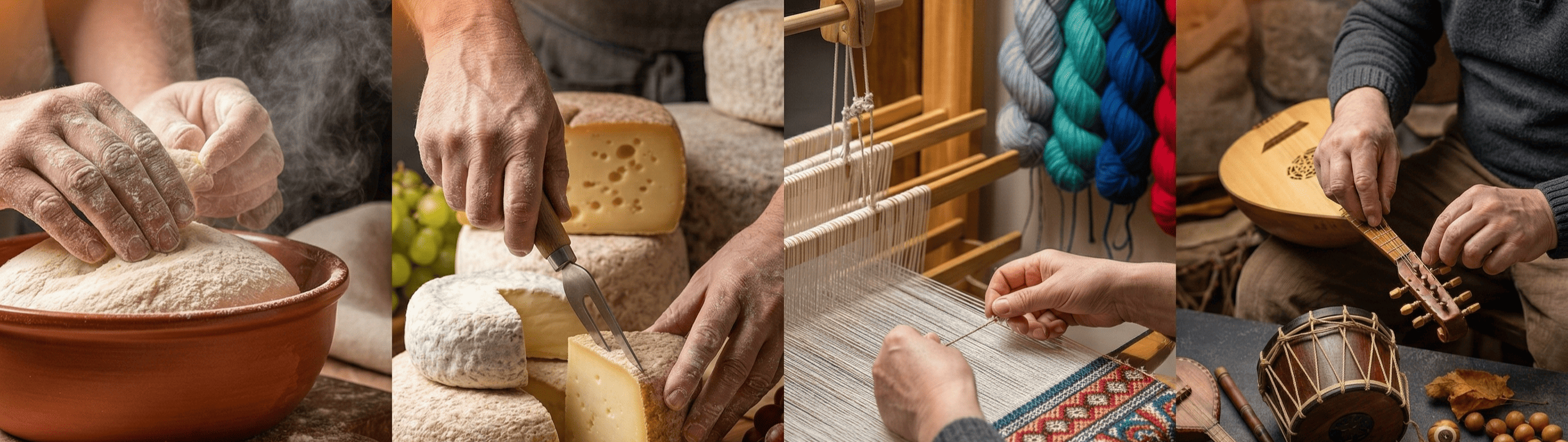
Our initiatives describe how the five operational areas can be applied in real projects — to demonstrate the adaptability of the CKF framework across different cultural contexts.
WHO WE ARE
OUR WORKS
GET INVOLVED
The Creative Knowledge Foundation is a US non-profit 501(c)(3).
Headquarters: 2660 E. Avenida de Pueblo, Tucson AZ 85718; Mailing address: PO Box 64538, Tucson AZ 85728
For more info visit our website or contact us
The Creative Knowledge Foundation is a US non-profit 501(c)(3).
Headquarters: 2660 E. Avenida de Pueblo, Tucson AZ 85718; Mailing address: PO Box 64538, Tucson AZ 85728
For more info visit our website or contact us